
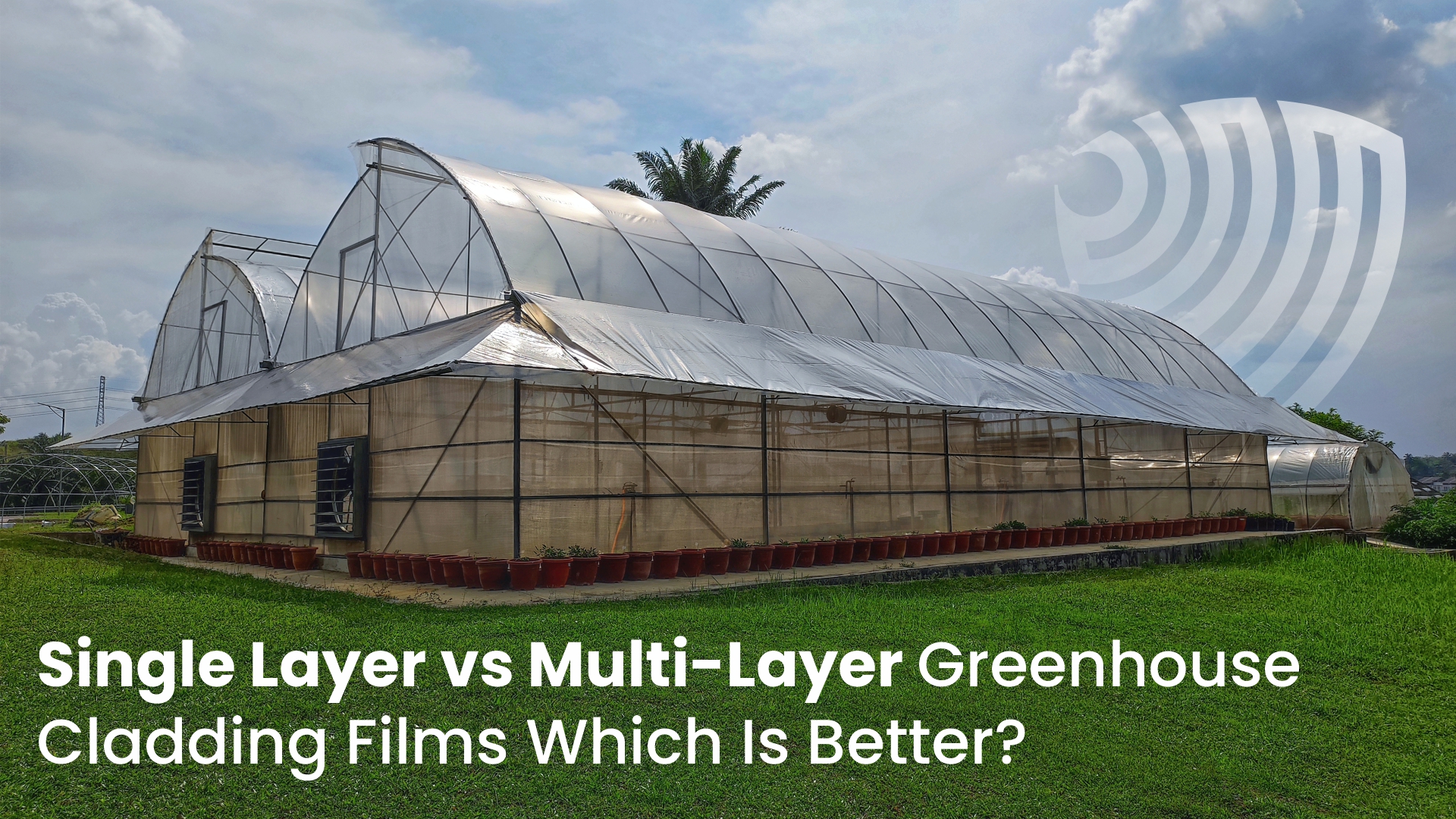
Selecting the most appropriate cladding material ranks among the pivotal choices that greenhouse operators must make. Indeed, the decision whether to use single-layer or multi-layer polyethylene films can alter the crop yields, energy expense, and ultimately the profitability of a business. Hence, it is indispensable to fully comprehend the distinctions between the two to invest wisely in a solution that is compatible with the nature of the crops and the local climate.
Understanding Single Layer Firm:
A single-layer greenhouse film is a unitary sheet of polyethylene plastic, most commonly between 4 and 6 mil in thickness. These films embody the conventional way of covering greenhouse and are still widely used by growers, particularly those operating in mild climates or running seasonal businesses. The major feature of single-layer films is their smallness. Fitting is easy, as it only takes one layer of the film to be pulled over and secured on the greenhouse frame. Such a simple construction equates with lesser input costs as well as shorter installation duration, and thus, single-layer risk is a suitable choice for growers on a limited budget or people who are new to greenhouse cultivation.
Contemporary single-layer films have not been left behind in the innovation competition; producers have loaded additives that raise the performance to a very high degree. The anti-drip agents prevent the water vapor from coming in big droplets that harm the plant and reduce the amount of light passing through the film, while UV stabilizers extend the lifetime of the film by shielding it from the sun’s rays against solar degradation, and infrared blockers help retain the heat during nighttime hours. Some high-quality single-layer films also have the light diffusion feature to scatter the direct sunlight and create more uniform lighting conditions.
Multi-layer films :
Breakthrough metroplex multi-layer films for greenhouse cladding are the future of greenhouseplastic technology. Multi-layer structures usually have three, five, or seven separate layers, where each layer is made for a definite purpose. The layers are not coated one on top of the other; they are coextruded, which means the layers are being produced simultaneously and thus a single film with numerous functional zones is created.
The complex multilayer structure is aimed at not only greenhouse insulation but also at creating alternative climate control possibilities in a greenhouse. In addition to that, a layer between two protective layers can be an anti-UV layer, a jacket can be a weatherproofing layer, a reinforcement layer can be added for structural strength, a heat-trapping middle layer can be an infrared emissivity retardant, the inside layer may contain anti-drip properties, or it may be an anti-fog one. This intricate layered approach allows producers to have full independent control over each function by adding that are incorporated into the particular layer instead of compromising the effect by trying to put all additives into one layer.
The thermal performance of the multi-layer membrane is significantly higher than that of the single-layer materials. This is due to the multilayer structure that presents a series of microscopic air pockets located between the layers, which provide the insulation.
This excellent heat retention may reduce the heating energy use by 15 to 30% compared to single-layer films, depending on the climate and the greenhousemanagement practices. Another field in which multilayer films have no equal is light management.
The advanced diffusion layers scatter incoming sunlight more effectively, thus removing hard shadows and hot spots while still maintaining a high level of light transmission. This soft light can go further into plant canopies, resulting in more uniform growth and, in some cases, higher yields. Certain multi-layer films can have light transmission levels of more than ninety percent while still offering excellent diffusion properties.
Durability and lifespan considerations:
Longevity is a very important aspect in the economic evaluation of greenhouse films. A single-layer film normally has a lifespan of about three to four years, but this could change depending on the weather conditions, UV radiation, and film quality. Since it is a single layer, when the film deteriorates, its performance is affected all at once.
Multi-layer films are more durable and thus their lifespan is generally longer than that of single-layer films, five to seven years or more. The different layers act as the redundancy levels; therefore, when the outer ones are getting worn, the inner layers continue to protect the greenhousestructure and the plants. This no longer life can be considered as the payback of the higher initial investment, thus it may seemingly result in lower annual cost despite the purchase having a premium price.
The enhanced tear resistance feature of multi-layer films also contributes to the lessening of the potential risk of a situation in which complete failures occur due to strong winds. Although both kinds of films have to be properly installed and maintained, multi-layer films are generally more resistant to physical stress, and as a result, there is less need for emergency repair, and the loss of the crop is limited.
Economic analysis :
Economic analysis is apparent from the initial investment point of view that single-layer films are the most advantageous. These films are generally 30 to 50% cheaper than their multi-layer counterparts. Such a cost difference can be significant for small-scale growers, seasonal farmers, or those living in mild climatic conditions and may lead to the choice of single-layer films despite their lower performance.
On the other hand, the total cost of ownership tells a different story. Multi-layer films offer savings on energy due to better insulation, which is replaced less frequently because of longer durability, and in some cases can increase yields by better light management. When these benefits are spread over their lifespan, multi-layer films are, in many cases, more economically viable for year-round operations in a harsh environment.
Making Your Decision :
Both single-layer and multilayer films keep getting better every year as the greenhouseindustry keeps innovating. Getting advice from knowledgeable suppliers and checking out the manufacturer's specifications will help you to pick a film that performs to your expectations and fits your budget.
In the end, the better option is the one that makes the most sense for you. Multi-layer films deliver better performance in most cases but come at a higher price. Simple layer films offer a low-cost option for many applications without the problem of overinvestment. Think through your priorities, do the math on lifecycle costs, and decide on the film that will be your greenhouse operations winning ticket in the long run.